⚽
Loading Scores...
.png)
The Rare Offside Rule That Preserved Egypt's Group Position
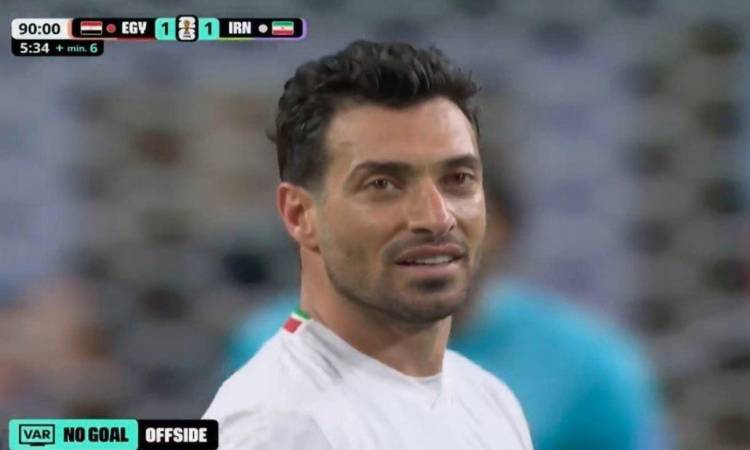
In one of the most controversial moments of the 2026 FIFA World Cup, Iran's celebrations after scoring a dramatic late goal against Egypt turned into disbelief after the Video Assistant Referee (VAR) intervened, revealing a rare offside situation that ultimately preserved Egypt's second-place finish in the group and confirmed the Pharaohs' Round of 32 matchup with Australia and sparked widespread debate over one of football's most misunders” and sparked widespread debate over one of football's most misunderstood laws.
The match, played in Seattle, United States, remained tense until the final seconds. Iran believed they had secured a historic victory deep into stoppage time before Polish referee Szymon Marciniak, following a VAR review, ruled the goal out in a decision that stunned millions of football fans around the world.
VAR Reveals the Hidden Offside
In the second minute of stoppage time, Iranian defender Shoja Khalilzadeh capitalized on confusion inside Egypt's penalty area and found the net after the ball deflected off goalkeeper Mostafa Shobeir. Iranian players and fans erupted in celebration, convinced they had secured all three points.

However, the celebrations were short-lived. The VAR officials called referee Marciniak to review the incident, and after examining the footage, he disallowed the goal, preserving the draw and maintaining Egypt's position as group runners-up.

What made the incident particularly extraordinary was that the initial replays appeared to show no obvious offside offense. Most fans are accustomed to judging offside based on the position of the last outfield defender, but the Egyptian goalkeeper's advanced positioning completely changed the equation.
A Rare Rule Saves the Pharaohs
According to the official Laws of the Game established by the International Football Association Board (IFAB), an attacking player must have at least two opponents between themselves and the goal line when the ball is played, with the goalkeeper counting as one of those two players.
In the disallowed goal incident, Shoja Khalilzadeh was positioned ahead of goalkeeper Mostafa Shobeir at the moment the ball was played, while only one Egyptian defender remained between him and the goal line. As a result, he was correctly deemed to be in an offside position under the laws of the game.
This type of offside situation is considered one of the rarest in modern football, which explains the confusion and controversy surrounding the decision despite its clear legal correctness.
The decision proved to be far more than a routine refereeing call. It became a defining moment in Egypt's World Cup campaign, allowing the Pharaohs to secure a draw and officially qualify for the Round of 32 as group runners-up, while Iran's dream of a historic last-minute victory vanished in dramatic fashion.
Related News
Haissem Hassan Dazzles Celtic Fans, but Is Match Fitness the Final Hurdle?
After Two Costly Defeats, What Does Egypt Basketball Need to Reach the 2027 World Cup?
Hamza Abdelkarim’s Barcelona Absence: Could Contract Talks Be Delaying His Debut?
Egyptian League Is Africa’s Strongest, but Ahmed Diab’s Middle East No. 1 Claim Lacks Evidence
Chinese President’s Visit Behind Al Ahly–Smouha Date Change? Cairo Stadium Mystery on September 1–2
MoreLatest News
Egypt Women’s Volleyball Reign Supreme in Africa.. Continental Title and Historic Qualification for the 2028 Olympics
Amouta: Emam Ashour May Need 3–4 Friendlies but Could Return Before International Break
Trabzonspor Add €17m Guinea-Bissau Striker Franculino Djú to Mohamed Salah’s Attack
Zamalek Defender Mahmoud Hamdy El Wensh Nears Egypt Return After Four Years Away
After Sweeping Rwanda 3-0, Egypt Women’s Volleyball Reach 2027 World Championship and Face Kenya for Olympic Berth
More


.png)



.svg.png)




.svg.png)