
Mbappé Left... So Why Is PSG Better Than Ever?
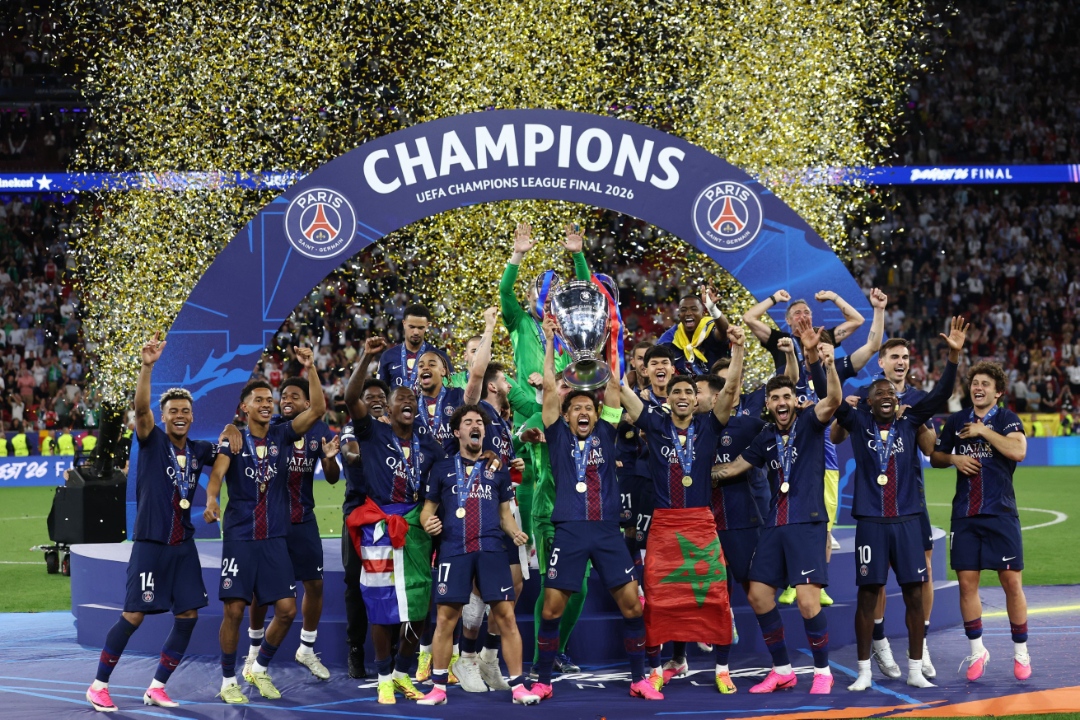
Copyright: PSG
Paris Saint-Germain’s second consecutive Champions League triumph was not just another achievement added to the French club’s trophy cabinet. It felt more like a clear announcement of the birth of a new footballing force in Europe, one no longer defined by money or the sparkle of superstar names, but by a system capable of defeating the elite and imposing a new reality on the continent.
For many years, Paris Saint-Germain remained part of the biggest football conversations as a club that seemed to have almost everything: stars, resources, and ambition. Yet it lacked the most important piece: a true European identity. The team often came close, shone at times, then collapsed in the moments that demanded more resilience than individual skill. But the current version of PSG looks completely different, as if the club needed to shed the weight of stardom in order to discover its real self.
From Stars to a Team
The irony is that Paris Saint-Germain did not reach its European peak during the era that brought together Lionel Messi, Neymar, and Kylian Mbappe, even though those names were theoretically enough to build an unstoppable side. But football, especially in the Champions League, does not reward those with the biggest names alone. It rewards those with the clearest idea and the strongest collective spirit.
After the departure of Kylian Mbappe, the player around whom PSG had built its project for years, many expected the club to enter a period of decline or a long search for a new identity. Instead, the opposite happened. Rather than becoming weaker without their biggest star, PSG evolved into a more balanced, collective, and complete team. The team freed itself from dependence on one player, became more collective and balanced, and transformed from a project built on individual flashes into an organized machine that knows how to press, defend, attack, and suffer together.
Luis Enrique was the key to this transformation. The Spanish coach did not deal with PSG as merely a group of names that needed technical management, but as a project that required a complete cultural rebuild. He placed the team above everyone and gave the players the belief that real strength does not come from one superstar, but from a group moving as one unit.
That change was clear throughout PSG’s path to the title. The journey was neither easy nor built on coincidence. It came through major clashes against clubs accustomed to standing at the top of European football. With every test, the French side offered fresh proof that it was no longer a heavy guest in the competition, but a genuine force in the battle for dominance.
Enrique and the Future
PSG’s success did not stop at the collective title. It also extended to the creation of new symbols within the squad. Among the most prominent of them is Warren Zaire-Emery, the young midfielder who found himself at the heart of an early historic achievement, becoming one of the youngest players to touch this level of European glory.
Zaire-Emery’s value does not lie only in the numbers he has achieved, but in the message he represents within PSG’s new project. A club that once searched for ready-made solutions from abroad now has a young player capable of becoming a symbol of its future. His presence in this golden period gives PSG an added dimension, because the team is not only winning in the present, but also shaping the years ahead.
As for Luis Enrique, he has strengthened his place among Europe’s elite coaches. His repeated Champions League success proves that he is not just a coach with one passing successful experience, but a manager who knows how to build teams capable of winning the toughest club competition in football. More importantly, he has succeeded in a mission that many before him failed to complete at PSG: turning huge resources into a real team.
Today, Paris Saint-Germain is no longer spoken of as a club trying to catch up with the giants, but as one of the giants itself. The French side has broken the old image that followed it for years and stepped out of the shadow of a star-filled project into a more mature and powerful version. What once looked like a distant dream has now become a new reality imposed on Europe.
Paris Saint-Germain did not only win the Champions League final. It defeated its old self. It defeated the idea that money alone creates glory, and the belief that individual stardom is enough to survive the toughest nights. In the end, the French club found its true path when it became a team before being a collection of names. Only then did it transform from a noisy project into a giant that knows how to rule Europe.