
.png)

World Cup Final Reignites Debate.. Was Argentina's Conduct a Recurring Pattern Throughout the Tournament?
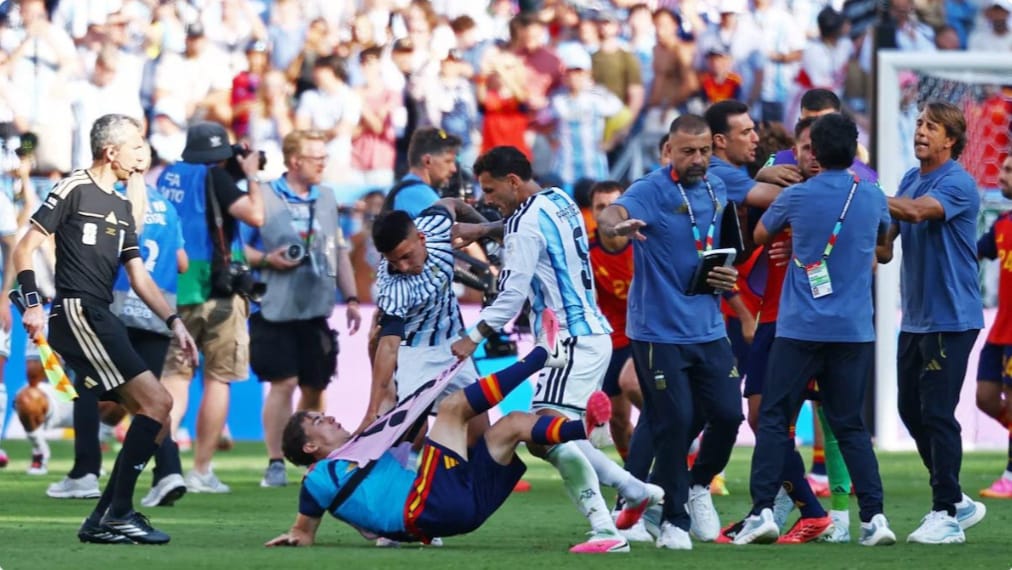
The confrontation that followed the 2026 World Cup final between Argentina and Spain reopened the debate over Argentina’s conduct during the tournament, after the post-match celebrations descended into tension between several players from both sides.
It was not the first time Argentina’s players had been at the centre of controversy during the competition, raising a wider question: was the final simply an isolated incident, or part of a pattern that had appeared more than once?
Egypt Match Brought the Issue Into Focus
For Egyptian fans, the debate began during the Round of 16 clash with Argentina.
The match featured repeated physical challenges, confrontations and protests, with some observers believing Argentina’s players crossed the line between intensity and excessive aggression.
Others argued that the incidents were simply part of the pressure and emotion that come with knockout football.
At the time, opinions were divided. However, the scenes after the final brought the Egypt match back into the conversation.
The Final Added Another Chapter
Following Argentina’s defeat to Spain, tensions flared on the pitch after the final whistle, with several players becoming involved in a heated confrontation before coaches and staff stepped in to calm the situation.

.jpeg)
Regardless of the details of each individual incident, the repeated appearance of such scenes during the tournament placed Argentina’s behaviour under renewed scrutiny.
Competitive Spirit or Loss of Control?
There is no doubt that Argentina possess a strong competitive mentality, and that fighting spirit has played a major role in the team’s success in recent years.
However, fierce competition does not prevent questions from being asked when tension, provocation and emotional reactions repeatedly become part of major matches.
The line between competitive intensity and losing control can be very thin.
Was the Egypt Match Really an Exception?
The events after the final do not prove that every criticism directed at Argentina following the Egypt match was justified. Nor do they mean that every physical challenge or confrontation was deliberate.
However, they make it more difficult to dismiss what happened against Egypt as a completely isolated case with no connection to the rest of Argentina’s World Cup campaign.
Each incident can be interpreted differently. But when similar scenes appear repeatedly, it is natural for them to become part of a wider discussion about the team’s behaviour during the tournament.